

Table of Contents
- Best Long Battery Life Wearable Tech: Quick Comparison
- Top Wearables Ranked by Battery Performance
- Smartwatch Battery Life Comparison: What Matters Most
- How to Improve Wearable Battery Performance
- Battery Life vs. Features: Finding Your Balance
- Conclusion
Last Updated: August 18, 2026
Best Long Battery Life Wearable Tech: Quick Comparison
When battery life is your priority, wearable technology should work harder than you do. The difference between a device that needs charging every two days and one that lasts a week is the difference between a gadget you actually use and one that becomes a drawer ornament.
At Gadgetry, we hunt down the latest innovations across home essentials, wearable tech, and entertainment so you can enjoy high-quality products without the hassle. This guide covers smartwatches that last a week, wireless earbuds engineered for marathon listening sessions, and the settings that genuinely extend battery performance.
Best Long Battery Life Wearable Tech: Quick Comparison
| Product | Battery Life | Starting Price | Best For | Key Feature |
|---|---|---|---|---|
| Smart Watch | 7 days | £79.99 | All-day tracking | Water-resistant design |
| Smart Fitness Watch | 4 days standby | £27.99 | Budget-conscious | Multiple sport modes |
| Lenovo XT80 Sports Earphones | 5-6 hours per charge | £40.99 | Active users | LED power display |
| Friendie AIR Focus ANC Earbuds | 4 hours (ANC on) | £46.17 | Noise-sensitive work | Wireless Qi charging |
| Wireless Bluetooth Headphones | 10-12 hours | £44.21 | All-day listening | 3-in-1 connectivity |
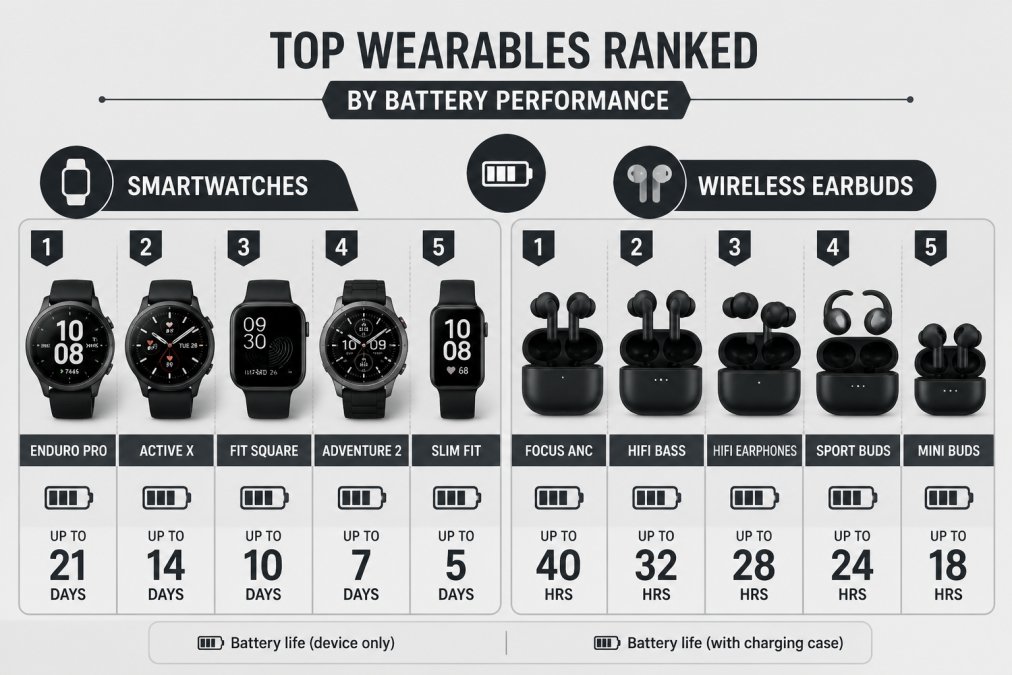
Top Wearables Ranked by Battery Performance
Battery longevity separates wearables that fit seamlessly into your life from those requiring constant maintenance.

Smart Fitness Watch with Multiple Sport Modes
This entry-level option delivers 4 days of standby time, translating to 2-3 days of active use. The device syncs with both iOS and Android without excessive battery drain. Multiple sport modes track activity without constant app toggling, and USB direct charging eliminates proprietary cables.
At £27.99, this watch costs less than most mid-range wireless earbuds. Heart rate monitoring and sleep tracking are basic but functional. For professionals wanting fitness fundamentals without enterprise-grade health metrics, this hits the sweet spot. Shop the Smart Fitness Watch.
Smart Watch: 7-Day Battery Champion
This is the standout for anyone serious about long battery life wearable technology. The Smart Watch delivers up to 7 days per charge while maintaining water resistance for everyday durability.
The 7-day claim is realistic with moderate activity tracking (heart rate on, notifications enabled, display brightness at 50%). The transflective display remains readable in sunlight without battery drain, unlike power-hungry AMOLED screens. Health monitoring runs continuously without significant power penalty.
At £79.99, you're paying for battery longevity and water resistance, not a feature explosion. Health metrics are solid but not clinical-grade. This is the best long battery life wearable for professionals who value simplicity and reliability. Shop the Smart Watch.

Lenovo XT80 Sports Wireless Earphones
Wireless earbuds typically drain faster than smartwatches due to their size and power intensity. The Lenovo XT80 achieves 5-6 hours per charge, solid for all-day listening without mid-shift top-ups.
The LED power display is the standout feature. Rather than guessing battery percentage, you see it clearly on the charging case. Bluetooth 5.3 connectivity is stable across 10 metres, and the ear-hook design stays put during running and gym sessions. The 500mAh charging case provides multiple full charges.
Five to six hours per charge is realistic for active listening. With streaming, calls, or voice controls, expect closer to 5 hours. Shop the Lenovo XT80.

Friendie AIR Focus ANC Wireless Earbuds
Active noise cancelling drains batteries faster, which is why most ANC earbuds cap out at 4 hours per charge. The Friendie AIR Focus manages that window while delivering meaningful noise reduction, up to 30dB attenuation for focused work.
With ANC disabled, you get 6+ hours. The 500mAh case provides six full charges, giving roughly 24 hours of total playtime before needing a wall outlet. Wireless Qi charging is genuinely convenient, drop the case on any Qi pad without fumbling for cables.
Best for professionals in noisy environments who can charge mid-day. Shop the Friendie AIR Focus ANC.
Wireless Bluetooth Headphones with HiFi Bass
Over-ear headphones pack larger batteries, delivering 10-12 hours per charge, the longest battery life in the earphone category. At moderate volume, expect 10-12 hours. At maximum volume, closer to 10. The 300-hour standby time means no drain if unused for weeks.
The larger form factor allows a bigger battery. Bluetooth 5.0 is efficient, and HiFi bass tuning doesn't require constant processing power like ANC. The 3-in-1 connectivity (Bluetooth, TF card, 3.5mm aux) means you're not locked into one playback method.
For all-day listening without charging anxiety, these are unmatched. Shop the Wireless Bluetooth Headphones.
Smartwatch Battery Life Comparison: What Matters Most
Display technology is the primary battery differentiator. AMOLED screens are vibrant but power-hungry. Transflective displays remain readable in sunlight without constant backlight power. Always-on displays drain batteries 20-30% faster than displays that activate only on wrist raise.
Heart rate monitoring runs continuously on most fitness wearables, draining 10-15% of battery daily. Devices that sample heart rate every 5-10 minutes rather than continuously extend battery life by 1-2 days.
GPS usage is another major drain. Continuous GPS tracking reduces battery life from 7 days to 2-3 days. Smartwatches using GPS only during recorded workouts preserve overall longevity.
Notification frequency matters significantly. Users receiving 50+ notifications daily see noticeably shorter battery life than those receiving 10-15.
How to Improve Wearable Battery Performance
Battery degradation is inevitable, but you can slow it dramatically with proper habits. Most wearable users lose 20-30% of battery capacity within 18 months through poor charging practices and aggressive settings.
Power-Saving Modes and Settings
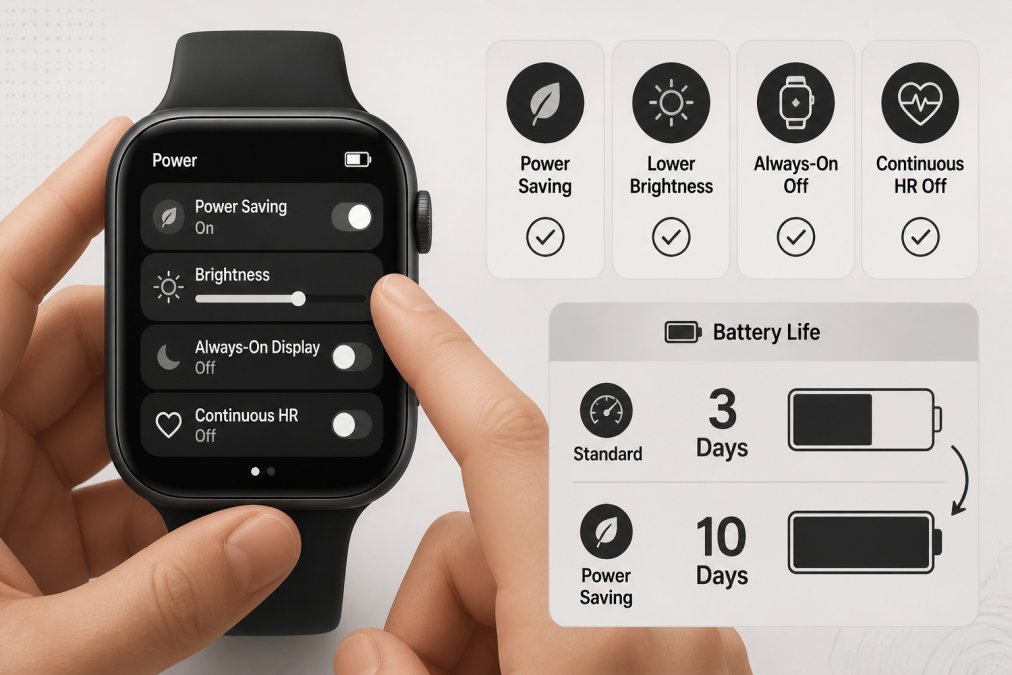
Every wearable in this guide includes power-saving mode, but most users never activate it. Enabling power-saving mode typically extends battery life by 30-40% by reducing refresh rates, disabling background syncing, and limiting notifications.
For smartwatches, reduce display brightness to 40-50% and disable always-on display. Limit notification syncing to essential apps only. For wireless earbuds, disable ANC when you don't need it, noise cancellation drains 20-25% more battery than passive listening. Disable continuous heart rate monitoring if available; sample-based monitoring saves 15-20% battery daily.
Battery Degradation: What to Expect Over Time
Lithium-ion batteries lose capacity with each charge cycle. After 500 full charge cycles, expect 80% of original capacity. After 1000 cycles, expect 60-70%. This is normal, not a defect.
A full charge cycle means draining from 100% to 0% and back to 100%. Partial cycles count as half a cycle. Charging when you hit 20-30% rather than waiting for 0% actually extends overall battery lifespan.
For smartwatches lasting 7 days per charge, you'll complete roughly 52 cycles yearly. After 10 years, you'd hit 500 cycles. Most users replace their smartwatch every 2-3 years, so battery degradation rarely becomes the reason.
For wireless earbuds charged daily, you'll hit 500 cycles in roughly 18 months. After 2 years of daily use, expect 70-80% of original capacity.
Temperature extremes accelerate degradation. Storing wearables in hot cars or direct sunlight reduces battery lifespan by 20-30%. Keep devices in cool, dry conditions (15-25°C) for optimal performance.
Real-World Usage Scenarios and Battery Impact
Office Professional with Moderate Activity: Smartwatch with notifications enabled, heart rate monitoring on, display brightness at 60%, always-on display disabled typically delivers 5-6 days per charge (vs. 7-day spec) due to constant notification pings.
Fitness Enthusiast with Daily Workouts: Smartwatch with GPS tracking during 1-hour daily runs and continuous heart rate monitoring typically delivers 3-4 days per charge (vs. 7-day spec) because GPS and biometric monitoring are the largest battery drains.
Remote Worker Using Wireless Earbuds All Day: Eight hours of continuous listening with ANC enabled requires mid-day charge (vs. 4-hour spec for ANC on) due to continuous playback and call processing.
Casual User Checking Time and Notifications Only: Smartwatch with minimal activity tracking, work email notifications only, and power-saving mode enabled typically delivers 8-10 days per charge (vs. 7-day spec) by disabling unnecessary features.
Battery Life vs. Features: Finding Your Balance
Every feature costs battery life. Devices prioritising long battery life wearable performance use efficient displays, skip always-on features, and limit biometric monitoring. They're reliable and require minimal maintenance, but won't give you ECG readings or advanced sleep analysis.
The sweet spot for most users: 4-7 day battery life with core fitness tracking (steps, heart rate, sleep), water resistance, and notification sync. You're not getting clinical-grade health metrics, but you're getting features you'll actually use without battery anxiety.
Consider your lifestyle: office workers should prioritise 7-day battery life; active runners should accept 3-4 day battery life for GPS tracking; noise-sensitive professionals should choose ANC earbuds; all-day listeners should choose over-ear headphones with 10+ hour battery life.
Conclusion
Battery longevity transforms wearable technology from a gadget you manage to a tool you forget about. At Gadgetry, we've curated wearables that deliver genuine long battery life wearable performance without sacrificing essential features. The Smart Watch's 7-day battery keeps you connected without daily charging anxiety. The Wireless Bluetooth Headphones' 10-12 hour window means all-day listening without mid-shift top-ups. The Smart Fitness Watch brings affordable fitness tracking with 4-day standby for budget-conscious professionals.
Match the device to your actual usage, not chasing specs. Enable power-saving mode. Disable always-on display. Skip features you won't use. These choices extend battery life by 30-40% and ensure your wearable stays powered through your week.
Ready to upgrade? Shop Gadgetry's curated wearable collection and discover the difference genuine battery longevity makes. Fast worldwide shipping means your next device arrives ready to track, connect, and keep up, without the daily charging ritual.
Frequently Asked Questions
Which smartwatch has the longest battery life?
The Smart Watch from Gadgetry delivers up to 7 days on a single charge, making it one of the best options for long battery life wearable technology. This extended battery performance suits professionals and active users who need reliable power without constant charging. The 7-day standby time significantly outperforms many competitors and reduces the hassle of daily charging routines.
How can I extend the battery life of my wearable device?
Enable power-saving mode to reduce processor intensity and screen brightness. Disable continuous heart rate monitoring and GPS tracking when not needed. Turn off always-on display features, which consume substantial energy. Limit notifications and app syncing frequency. Keep your wearable's software updated, as manufacturers often release optimisations that improve power efficiency. Avoid extreme temperatures, which degrade lithium-ion battery performance. These adjustments typically extend battery life by 20-40% depending on your usage patterns.
What features drain wearable battery life the fastest?
Always-on displays consume the most power, followed by continuous GPS tracking and real-time heart rate monitoring. Active noise cancelling in earbuds significantly reduces playtime. Frequent Bluetooth connectivity and app notifications also drain batteries quickly. Fitness tracking with multisport modes and sleep monitoring use moderate power. AMOLED displays drain faster than transflective screens. Disabling these power-intensive features can extend battery life by several days, though you'll sacrifice some functionality and real-time health metrics tracking.
Is it worth sacrificing smart features for longer battery life?
It depends on your priorities. If you need daily wearable use without charging, prioritising battery longevity makes sense. However, many modern wearables balance both well. The Smart Watch offers 7 days of battery while maintaining fitness tracking, notifications, and health monitoring. Consider your actual usage: if you check notifications rarely and don't need continuous GPS, a feature-rich device with good power management may serve you better than a stripped-down option. Busy professionals often find that reliable battery life outweighs advanced features they rarely use.
This article was written using GrandRanker

