

Table of Contents
- Why Wearable Tech Privacy Matters in 2026
- What Data Your Wearables Actually Collect
- UK GDPR Wearable Device Compliance Explained
- How to Secure Health Data on Smartwatches
- Your Biometric Data Protection Rights
- Privacy Risks and How to Mitigate Them
- Choosing Privacy-Conscious Wearables
- Conclusion
Last Updated: August 14, 2026
Why Wearable Tech Privacy Matters in 2026
Wearable tech privacy has shifted from a convenience concern to a critical security issue. Your smartwatch, fitness tracker, and health monitoring devices collect continuous biometric data, heart rate, sleep patterns, location, movement, 24 hours a day. This information is more sensitive than your passwords. Unlike a breached email account, compromised health data can affect insurance rates, employment prospects, and personal safety.
A single smartwatch generates thousands of data points daily. Most users never review where that data goes, who accesses it, or how long it's retained. The good news: you can protect yourself with practical steps and informed device choices.
This guide covers what wearables actually collect, your legal rights under UK GDPR, how to secure your health data, and how to choose devices built with privacy-by-design principles.
What Data Your Wearables Actually Collect
Your wearable captures far more than step counts. Modern smartwatches and fitness trackers collect heart rate variability, sleep architecture, blood oxygen saturation, skin temperature, movement patterns, stress levels, menstrual cycles, and respiratory rate. This is personal health information, the most sensitive category of biometric data.
The collection happens silently. Your device's sensors run continuously, transmitting data to cloud servers where it's stored, analysed, and often shared. Sensor data flows through multiple systems: the device itself, the manufacturer's cloud infrastructure, third-party analytics platforms, and sometimes data brokers.
Location tracking compounds the risk. Your wearable knows where you exercise, when you're home, and your travel patterns. Combined with health data, this reveals your medical appointments, mental health struggles, and daily routine.
The permissions you grant during setup are often vague. "Access to health data" might mean the app can read your steps or detailed heart rate trends. Most users tap "agree" without reading the specifics. That's where data sovereignty, your right to control your own information, gets lost.
Third-party integrations multiply the exposure. Many fitness apps connect to social networks, health platforms, or workplace wellness programmes. Each integration is another pathway for your data to travel. Once your information leaves the device manufacturer's servers, it becomes subject to each third party's privacy policies, which often differ significantly from the device maker's commitments.
UK GDPR Wearable Device Compliance Explained
UK GDPR wearable device compliance is the legal framework protecting your health data. Under the UK General Data Protection Regulation, wearable manufacturers and app developers must treat biometric data as special category personal data, the highest protection level. This means explicit consent is mandatory before collection, and data minimisation principles apply: companies can only collect what they genuinely need.
The regulation gives you specific rights. You can request what data a company holds about you, demand deletion of unnecessary information, and withdraw consent at any time. You can ask for data portability, receiving your information in a machine-readable format. If a company breaches your data, you have the right to compensation. These are enforceable legal protections.
In practice, enforcement is inconsistent. The Information Commissioner's Office (ICO) oversees GDPR compliance, but resources are limited. The burden falls on you to understand what consent you're giving and to actively manage your data permissions.
Informed consent is the legal linchpin. A company cannot simply collect health data because it's technically possible. They must explain what data they collect, why, how long they keep it, and who they share it with, in clear language. Many wearable manufacturers fail this test, burying privacy policies in 50-page terms of service.
Data retention policies are where compliance often breaks down. Many wearables retain your data indefinitely. UK GDPR requires data deletion once the original purpose is fulfilled. Few companies delete data without explicit requests, instead claiming they need to retain it for "research" or "service improvement", vague justifications that don't meet GDPR standards.
Cross-border data transfers create compliance gaps. Your data might be processed in the US, EU, or Asia. UK GDPR still applies to UK residents' data, but enforcement becomes complex when data crosses borders. Companies must ensure equivalent protections exist in destination countries, which rarely happens transparently.
How to Secure Health Data on Smartwatches
Securing health data starts with device-level controls. Most smartwatches offer authentication, encryption, and permission management, but they're often disabled by default.
Enable Authentication and Encryption
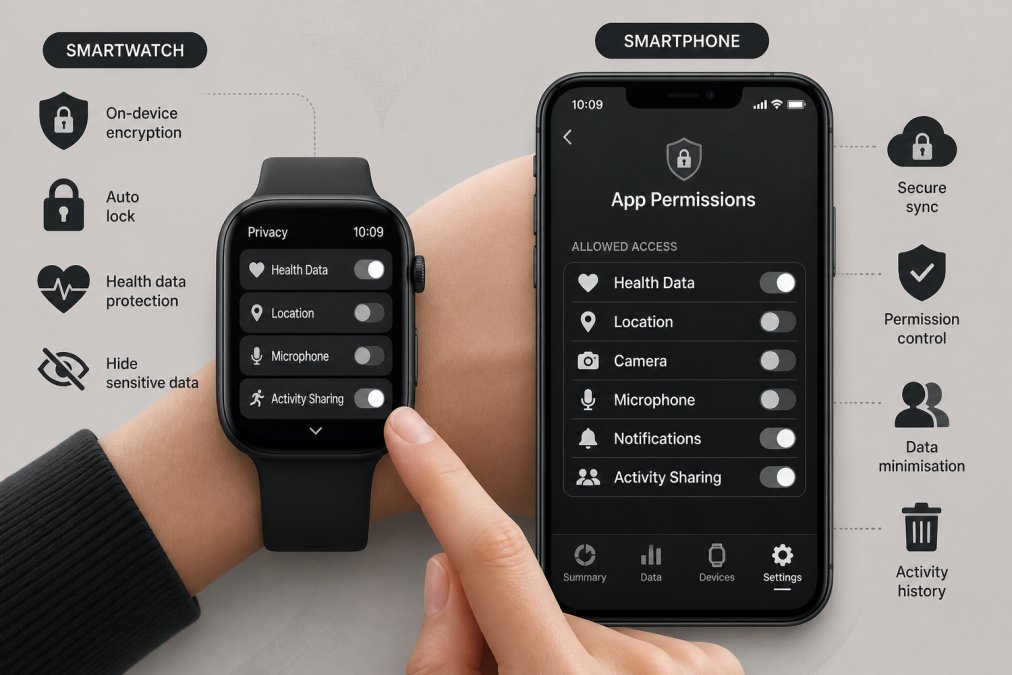
Set a strong PIN or biometric lock on your smartwatch. This prevents physical access if your device is lost or stolen. Enable Bluetooth encryption on your watch to secure data transmitted between your device and smartphone. Most modern smartwatches use encrypted Bluetooth by default, but verify this in your device settings.
Ensure your smartphone is also secured. Your smartwatch syncs with your phone, so a compromised phone compromises your wearable data. Use a strong unlock code (minimum 6 characters, ideally 12+), enable two-factor authentication on your primary accounts, and keep your phone's operating system updated.
Review and Restrict App Permissions
Open your wearable's app settings and audit which apps have access to health data. Delete apps that don't need health data access. A weather app, for example, has no legitimate reason to read your heart rate.
On your smartphone, navigate to health app settings and check which third-party apps are connected. Disconnect services you don't actively use. Check notification permissions and disable them for sensitive apps, as notifications can reveal sensitive health information to anyone with physical access to your device.
Manage Cloud Synchronisation Settings
Most smartwatches sync data to cloud servers automatically. Review your manufacturer's cloud settings and disable automatic uploads if possible. Some devices offer local-only storage options or manual sync, which reduces exposure to cloud-based breaches.
If you must use cloud sync, enable any available encryption options. End-to-end encryption, where only your device can decrypt your data, is the gold standard. Check your cloud backup settings and verify what's being backed up and where it's stored. Set automatic data deletion policies if your wearable offers them, allowing you to delete data older than 30, 90, or 365 days.
Your Biometric Data Protection Rights
You have legal rights over your biometric data under UK GDPR. Your right to access means any company holding your health data must provide a complete copy within 30 days of your request, including data you've never seen, backend analytics, and historical records.
The right to deletion allows you to demand erasure of your data when it's no longer necessary for the original purpose, when you withdraw consent, or when the company has no legal basis to retain it. Wearable manufacturers often resist deletion requests, claiming they need data for "research" or "service provision," but UK GDPR allows limited exceptions.
Data portability gives you the right to receive your information in a machine-readable format and transfer it to another service. Many wearable manufacturers don't support portability, which violates GDPR. Your right to object applies to certain processing activities like direct marketing or profiling. The right to restrict processing lets you pause data processing without requiring deletion.
Automated decision-making rights protect you from decisions made purely by algorithms. If a company uses your wearable data to make decisions affecting you, like insurance pricing or employment eligibility, you have the right to human review and explanation.
To exercise these rights, contact the company's Data Protection Officer or privacy team in writing. Document your request with dates and details. If a company ignores you or refuses without valid reason, escalate to the ICO.
Privacy Risks and How to Mitigate Them
The primary privacy risk is data breach. Wearable manufacturers store millions of users' health records in centralised databases. Recent breaches have exposed heart rate data, location history, and user identities. Mitigation: choose manufacturers with strong security track records, enable device-level encryption, and monitor breach notification databases.
Secondary use is a subtler risk. Your wearable data might be sold to insurers, employers, or data brokers without your explicit knowledge. Privacy policies often contain clauses permitting "research" or "business purposes," which are vague enough to justify almost anything. Mitigation: read privacy policies carefully, revoke permissions you don't need, and opt out of data sharing where possible.
Inference attacks represent an emerging threat. Companies don't need to collect your diagnosis to infer it. Your heart rate variability patterns, sleep disruption, and activity changes can reveal mental health conditions, pregnancy status, or serious illness. Mitigation: understand what your data reveals beyond surface metrics.
Device compromise is a physical risk. If your smartwatch is stolen or lost, an attacker with physical access can extract data if your device isn't locked. Mitigation: set a strong PIN, enable biometric locks, and consider remote wipe capabilities if your device supports them.
API security risks emerge when wearables integrate with other services. A compromised third-party app or weak API authentication can expose your data to unauthorised access. Mitigation: audit app connections regularly and disconnect unused integrations.
Choosing Privacy-Conscious Wearables
Privacy-conscious wearable design starts with minimisation. The best devices collect only what you actually need, not everything technically possible. A fitness tracker that monitors steps, distance, and calories is sufficient for most users.
Transparency in privacy policies matters enormously. Compare two manufacturers' privacy documents. One explains what data is collected, why, who accesses it, and how long it's retained in plain language. Another uses vague terms like "analytics purposes." The first is trustworthy; the second is hiding something.
Check whether the manufacturer offers end-to-end encryption. This is rare among consumer wearables, but it's the gold standard. Verify data retention policies, the best manufacturers allow you to configure how long data is kept or offer automatic deletion after 30, 90, or 365 days.
Look for local processing options. Devices that can process data locally on your wearable or smartphone rather than sending everything to cloud servers are inherently more private. Check whether the manufacturer is transparent about third-party sharing and whether you can opt out.
At Gadgetry, we curate wearables with privacy-conscious design. Our Smart Fitness Watch with Multiple Sport Modes at £27.99 prioritises local data processing and transparent privacy settings. For users wanting more advanced health monitoring, our Smart Watch at £79.99 offers enhanced security features including configurable data retention and granular permission controls. Both devices support local storage and offer straightforward privacy policies without vague "research purposes" clauses.



If you're concerned about screen privacy while managing your wearable settings on your laptop, our Privacy Screen at £22.99 prevents shoulder surfing when you're adjusting sensitive privacy configurations or reviewing your health data.

For premium users, our Graphite Aluminum Smart Watch at £489.00 and Aluminium Body Smartwatch at £399.00 include enterprise-grade security features, hardware-level encryption switches, and compliance certifications for healthcare use.
Avoid devices with forced cloud synchronisation. If a manufacturer requires internet connection and cloud backup to use basic features, they're prioritising data collection over user choice. Research the manufacturer's security history. Have they had data breaches? How did they respond? A company's past behaviour predicts future practices.
Check whether the device supports data portability. Can you export your data in a standard format? Devices that lock you into proprietary ecosystems are less privacy-conscious than those offering open data formats.
Wearable tech privacy isn't a one-time setup. It's an ongoing process of reviewing permissions, auditing connections, and understanding what data you're generating. At Gadgetry, we believe privacy-conscious technology enhances your life rather than compromising it. Review your wearable's privacy settings today, audit your app permissions, and choose devices that respect your data. Your health information deserves protection equal to your most valuable assets.
Frequently Asked Questions
How does the UK GDPR apply to wearable technology data?
Under UK GDPR, wearable manufacturers must obtain explicit consent before collecting personal health data, implement data minimisation practices, and ensure your data is encrypted during storage and transmission. You have the right to access, correct, and delete your personal information. Manufacturers must also conduct Data Protection Impact Assessments and report breaches within 72 hours to the Information Commissioner's Office. This applies whether the company is based in the UK or operates within UK territory.
What are the biggest privacy risks of using smartwatches and fitness trackers?
The main risks include unauthorised data sharing with third parties, inadequate encryption leaving biometric data vulnerable during cloud synchronisation, and data harvesting for AI-driven health profiling without informed consent. Wearables also create a persistent digital footprint that can be linked to your identity, location, and health conditions. Poor user authentication allows unauthorised device access, and many devices retain data indefinitely rather than following data retention policies. Interoperability with multiple apps and platforms increases your cybersecurity risk surface.
Can wearable device manufacturers sell my health data in the UK?
No. Under UK GDPR and the Data Protection Act 2018, manufacturers cannot sell your personal health information without your explicit, informed consent. You must be told exactly how your data will be used before agreeing. However, manufacturers can share anonymised data for research if it's genuinely de-identified. Many privacy policies allow data sharing with business partners for 'service improvement', read these carefully. You can withdraw consent at any time, and the manufacturer must delete your data upon request unless they have a legal obligation to retain it.
What are my rights under the Data Protection Act 2018 regarding biometric data?
Biometric data (fingerprints, face recognition, heart rate patterns) receives special protection under UK GDPR as sensitive personal data. You have the right to know exactly what biometric information is collected and how it's processed. You can request access to all your biometric data, correct inaccuracies, and demand deletion. Manufacturers must use privacy-by-design principles and conduct security auditing. If a company breaches your biometric data, you can claim compensation. They cannot process this data without clear legal grounds and your explicit consent.
How can I check the privacy settings on my wearable device?
Start by accessing your device's companion app and navigating to Settings > Privacy or Security. Disable cloud synchronisation if you don't need it, restrict which apps can access sensor data, and turn off location tracking. Check whether biometric authentication (fingerprint or face unlock) is enabled, this prevents unauthorised access. Review the privacy policy in the app's settings menu to understand data retention policies and third-party integrations. Disable Bluetooth when not actively using the device, and regularly review which apps have permission to access your health data. For smartwatches, check manufacturer-specific privacy dashboards for additional controls.
Are there privacy-focused wearable devices available in 2026?
Yes. Look for wearables that emphasise privacy-by-design, offer hardware-level privacy switches, and provide transparent data governance. Some manufacturers now offer post-purchase data deletion rights and local data processing (keeping your information on the device rather than syncing to the cloud). Check product specifications for end-to-end encryption, open-source security auditing, and compliance with UK GDPR. Gadgetry curates wearables with strong privacy credentials, our Smart Fitness Watch (£27.99) and Smart Watch (£79.99) prioritise user-controlled privacy settings and minimal data collection. Always verify the manufacturer's regulatory compliance status before purchasing.
What should I do if my wearable's privacy policy changes?
You're entitled to be notified of material changes to privacy policies. Review the notification carefully and assess whether the new terms are acceptable. If the change involves expanded data sharing or reduced privacy protections, you can withdraw consent and stop using the device. Request deletion of all your data if you disagree with the new terms. Document the old privacy policy (screenshot or PDF) for your records. If you believe the change violates UK GDPR, you can file a complaint with the Information Commissioner's Office. Many manufacturers now allow you to opt out of specific data practices without losing core functionality.
How do I know if my wearable's data has been breached?
Manufacturers are legally required to notify you within 72 hours of discovering a breach affecting your personal data. Check your email and the manufacturer's website for breach notifications. If you don't receive notification but suspect a breach, contact the company's data protection officer directly. You can also check the Information Commissioner's Office's public register of reported breaches. Once notified, change your device password immediately, review your account activity for unauthorised access, and monitor your health data for suspicious changes. Consider using a privacy screen (like Gadgetry's Privacy Screen at £22.99) to prevent shoulder surfing when checking sensitive health information on your device.
This article was written using GrandRanker

